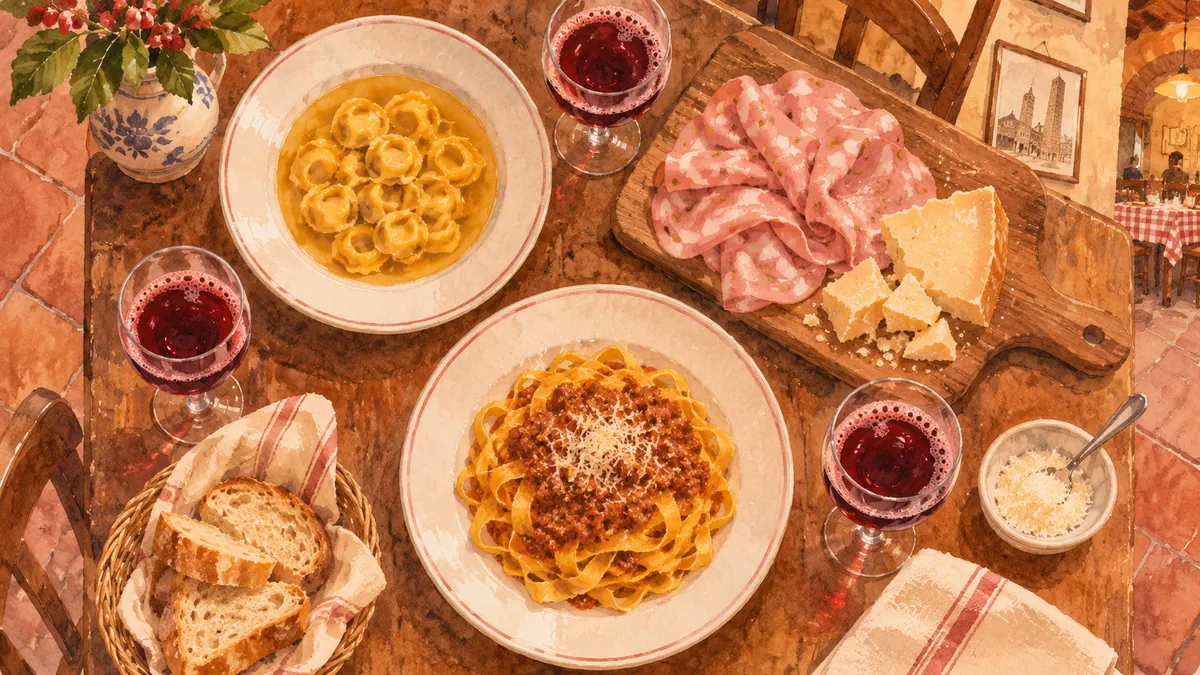
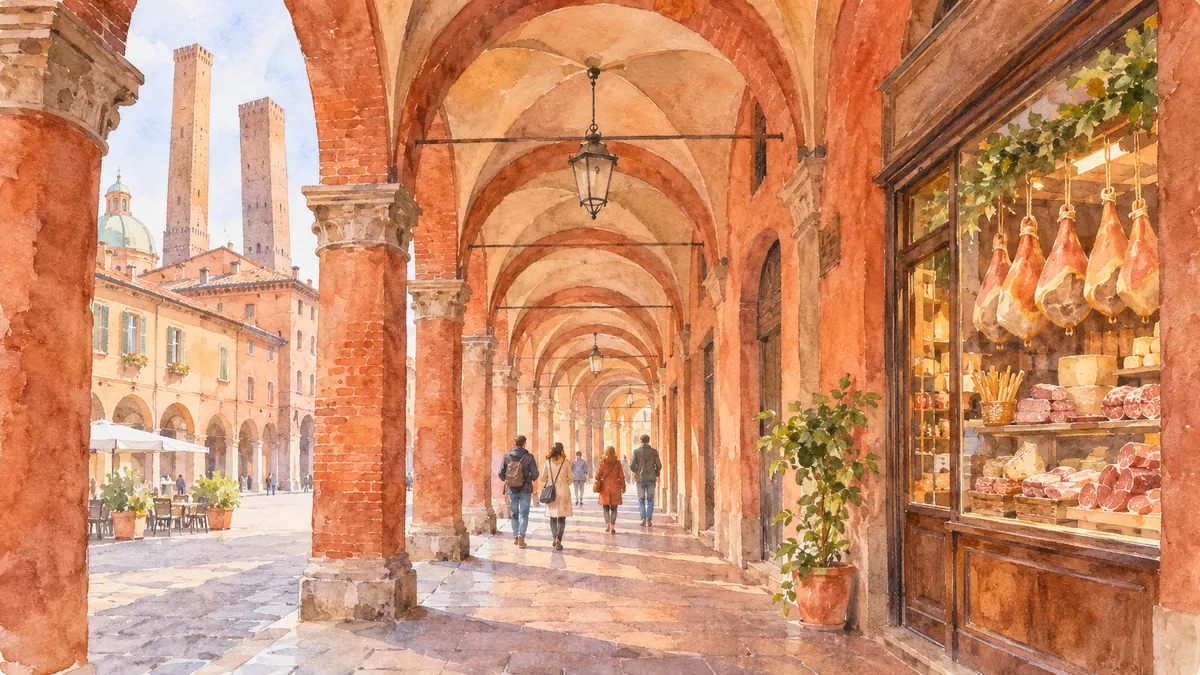
Bologna writes its food down. The ragù, the tortellino and the width of a tagliatella are registered recipes held by the city’s Chamber of Commerce, and mortadella, Parmigiano Reggiano, Prosciutto di Parma and traditional balsamic follow EU rules on how they are made and aged. Ragù goes on tagliatelle, never spaghetti, and tortellini come in broth, not cream. On a walking food tour you taste most of these rules in one morning or evening, with a guide explaining each one at the counter.
Bologna street food tour, 2 hours
Spaghetti Bolognese and the Registered Ragù
In 2019 the then-mayor of Bologna, Virginio Merola, asked people to send photos of spaghetti bolognese served around the world and told Italian radio the dish does not exist in Bologna. The city’s ragù goes on fresh egg tagliatelle, on lasagne or on gramigna, a short curly pasta.
The recipe is on file. The Accademia Italiana della Cucina first deposited it on 17 October 1982 and replaced it with a renewed recipe deposited on 20 April 2023, its first update in 41 years. The new version uses less pancetta, swaps the beef cut from skirt to a leaner cut, adds olive oil, and still includes milk.
You eat ragù with tagliatelle at lunch on our featured small-group walk, at the trattoria stop on the Bologna: Walking Food Experience with a local, and in the pasta class, where you roll the tagliatelle yourself.
Tortellini and Tagliatelle by the Numbers
The tortellino filling was registered by notarial deed on 7 December 1974: pork loin, prosciutto crudo, Mortadella Bologna, Parmigiano Reggiano, eggs and nutmeg, enough for about 1,000 tortellini, each weighing 5 grams. The registered broth uses half a capon, beef shank and a rind of Parmigiano. Tortellini are served in broth, which is why Bologna guides wince at cream sauce. The story that the shape copies Venus’s navel comes from a mock-epic poem written in 1908, not from history.
The tagliatella has a size too. Its standard, deposited on 16 April 1972, sets the cooked width at 8 mm, said to be 1/12,270 of the height of the Asinelli tower, and a gold sample is kept at the Chamber of Commerce. The arithmetic is a local joke more than a measurement.
The walk with a local serves tortellini and tagliatelle at a trattoria. The Bologna: Street Food Tour in the Historic Center serves fried tortellini with Parmigiano cream, a street-food version, so ask your guide how it compares with tortellini in brodo.
Other experiences
Other Bologna food experiences
More ways to explore the area. Each listing shows its own cancellation policy.
Mortadella Is Cooked, Not Cured
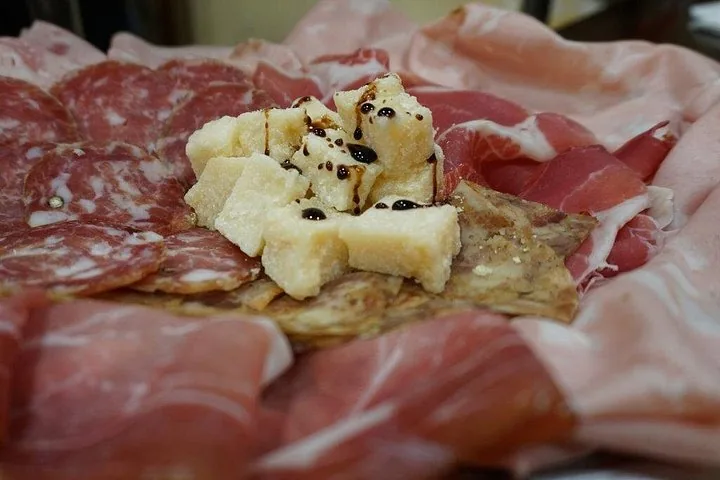
Mortadella Bologna has been an EU-protected IGP product since 1998. Finely minced pork is studded with cubes of pork throat fat, which must make up at least 15% of every slice, and the sausage is cooked in dry-air ovens until the center reaches at least 70 °C. It is not cured or smoked, pistachio is optional, and the rules allow it to be made in eight Italian regions, not only around Bologna. Bologna dates its rules to 24 October 1661 and a decree under Cardinal Farnese, and celebrates every 24 October as Mortadella Day.
You taste mortadella at the osteria stop on the featured walk, in a sandwich on the 2-hour Express option of the Bologna: Local Food Tour with Authentic Tastings and Wine, on the cured-meat board of the street food tour and with piadina at the start of the pasta class.
Parmigiano Reggiano and Prosciutto di Parma
Parmigiano Reggiano DOP is made only from raw, partly skimmed milk, salt and rennet, from cows that may never eat silage. Each wheel needs about 550 liters of milk, and every wheel is tested with a hammer at 12 months, the minimum age; the 24- and 36-month cheeses you taste are aged longer by choice. The cheese is naturally lactose-free, because the lactose ferments away within about 48 hours of making, so ageing is not the reason.
Prosciutto di Parma DOP is pork and sea salt, with no smoking and no additives. Since legs entering production on 4 September 2023, the minimum ageing is 14 months, up from 12, and only hams carrying the ducal-crown brand can be sold as Parma.
Parmigiano appears on nearly every walk, and Prosciutto di Parma is on the 3-hour Secret Food Tours menu. To see Parmigiano made, the Food Valley day visits a dairy near Modena and tastes wheels aged 12, 24 and 36 months.
Traditional Balsamic and the Supermarket Kind
Two different products share the word balsamic. Aceto Balsamico Tradizionale di Modena DOP is cooked grape must only, aged at least 12 years (Affinato) or at least 25 years (Extravecchio), and sold only in a 100 ml bottle designed in 1987 by the car designer Giorgetto Giugiaro. Aceto Balsamico di Modena IGP, the kind sold in supermarkets, is wine vinegar with cooked or concentrated must, may contain caramel and needs only two months of ageing.
The featured walk pours balsamic aged 15 and 25 years, the walk with a local serves a 25-year-old balsamic on Parmigiano, and the 3-hour Secret Food Tours walk tastes vinegars aged 8 to 25 years. The Food Valley day tours a balsamic cellar.
Cappuccino, Tigelle and Crescentine
“No cappuccino after lunch” is one of the house rules the featured operator lists next to “no spaghetti bolognese”, and Bologna’s cafés follow it: milky coffee belongs to the morning, and an espresso comes after a meal. The featured walk starts at a café with coffee and a pastry; order your cappuccino there.
Bread starts arguments. In Bologna, crescentine are fried dough, the same thing Modena calls gnocco fritto. Bologna’s tigelle are small baked rounds, which Modena calls crescentine; the word tigella first meant the terracotta discs they were baked between. Tigelle open the walk with a local, come with the 2-hour Express and appear at the dairy on the Food Valley day.
Which Walking Tour Tastes Which Rule
| Food rule | Where you taste it |
|---|---|
| Ragù on tagliatelle | Featured walk lunch; walk with a local; pasta class |
| Tortellini | Walk with a local (trattoria); street food tour (fried, with Parmigiano cream) |
| Mortadella IGP | Featured walk; Secret Food Tours; walk with a local; street food tour; pasta class |
| Parmigiano Reggiano | Every walk compared here except the 2-hour Express; Food Valley dairy |
| Traditional balsamic | Featured walk (15 and 25 years); walk with a local (25 years); Secret Food Tours (8–25 years); Food Valley cellar |
| Tigelle | Walk with a local; Secret Food Tours Express; Food Valley dairy |
For the full menus, read how much food you get on each tour, and to choose one, which Bologna food tour is right for you. Each tour page has its own menu: the Secret Food Tours walk, the walking tour with a local and the evening food walk.
Questions About Bologna’s Food Rules
Is spaghetti bolognese from Bologna?
Not as Bologna eats it. The city’s ragù goes on fresh egg tagliatelle, lasagne or gramigna, and in 2019 the then-mayor, Virginio Merola, called spaghetti bolognese fake news. The registered ragù recipe was last renewed on 20 April 2023.
How much does a tortellino weigh?
The recipe registered on 7 December 1974 sets each tortellino at 5 grams, with a filling of pork loin, prosciutto, mortadella, Parmigiano, eggs and nutmeg, served in broth.
Why is Parmigiano Reggiano lactose-free?
The lactose ferments away within about 48 hours of making, according to the Parmigiano Reggiano consortium. Every wheel is aged at least 12 months, but ageing is not the reason.
What is the difference between traditional balsamic and balsamic vinegar of Modena?
Traditional balsamic DOP is cooked grape must aged at least 12 or 25 years and sold in a 100 ml bottle. Balsamic vinegar of Modena IGP mixes wine vinegar with must and needs only two months of ageing.
Check Dates for the Bologna Street Food Tour
Aged Parmigiano with balsamic, fried tortellini, a cured-meat board, two glasses of wine and gelato in two hours. Pick a date to see the price.
Check Dates on Viator